Sunday, April 27, 2008

International Collegiate Programming Contest

Dean of Stanford University believes Iran's Sharif University ofTechnology has the best under graduate Electrical Engineering school in the world. .

Aryamehr University of Technology ( Called Sharif university, post revolution) claims the 13 place at the International Programming Contest

Russian, US Universities Claim Top Spots at International Programming Contest
St. Petersburg takes championship; MIT places second; three Russian teams among top five finishers.

The 32nd ACM International Collegiate Programming Contest (ICPC) took place April 6 to 10 in Banff, Alberta, Canada. One hundred teams advanced to the Finals from regional competitions held around the world. With IBM's sponsorship, begun in 1997, participation has increased eightfold, extending the opportunity to more students to compete for awards, prizes, scholarships, and bragging rights.
See all final results.
Read the press release.

1 St. Petersburg University of IT, Mechanics and Optics 8 1187
2 Massachusetts Institute of Technology 7 997
3 Izhevsk State Technical University 7 1008
4 Lviv National University 7 1010
5 Moscow State University 7 1165
6 Tsinghua University 7 1347
7 Stanford University 7 1354
8 University of Zagreb 7 1404
9 University of Waterloo 7 1597
10 Petrozavodsk State University 6 819
11 St. Petersburg State University 6 826
12 Belarusian State University 6 857
13 Moscow Institute of Physics & Technology 6
13 Warsaw University 6
13 Sharif University of Technology 6 (Aryamehr University)
13 Orel State Technical University

Read more!

Saturday, April 26, 2008

Friday, April 25, 2008

Iranian News :o)

Read more!

Once in every lifetime--Jem


It's time to move out of the darkness
Use what you feel inside
Your faith alone will guide you
Feel the turning tide

[Pre-chorus:]
It's n your heart, it's in your soul
Don't be scared, keep believing
I know you know, deep inside
That your time has come

[Chorus:]
Once in every lifetime
If you do believe
Man can move a mountain
Change the course of history
How far we've come
So far from home

Trust in your path, you've been chosen
Become your destiny
Lead and they will follow you
Your truth will set you free

Read more!

Stop the Violence

Read more!

Wednesday, April 23, 2008

Introducing Many Traditional and Folkloric Iranian Dances


The Iranian dance group founded by Aram Bayat in Montreal

Khorshid Khanoom dance group has taken upon itself the responsibility of introducing traditional and folkloric Iranian dance to the young generation of Iranian Canadians, to citizens of the host country (Montreal, Canada) and to the world.

Read more!

Monday, April 21, 2008

Room for Three???

The American-Saudi-Iranian "understanding" in Iraq:

Iran's support for al-Hakim and Sadr, prior to and after the war, eventually had to reach the point of making preferences, especially at such a critical period. The upcoming provincial council elections will determine the future of Southern Iraq and the relationship of the periphery to the central authority. It is in Iran's interest for al-Hakim to wield influence in this region which borders Iran. However, if the Mahdi Army wins the elections, which is highly probable, and continues to maintain its position unchanged, Iran will lose its long-term bet on a weak and divided Iraq. Moreover, even if al-Sadr himself supported federalism, his Movement would suffer divisions as it is constituted of diverse groups, some with Arabist and others with Islamist orientations. Consequently, this explains the repeated official and American announcements that al-Sadr is not personally targeted and that all he needs to do is to lift the political cover off al-Mahdi Army and become involved in the political process.

Biden managed to win congressional approval for his plan to partition Iraq. The new Iraqi Army, in cooperation with the militia of al-Hakim and US forces, started the implementation phase in Basra. Iran, on the other hand, awaits the opportunity to reap the gains and will have no qualms over sacrificing al-Sadr and his friendship.

Read more!

Ayatollah Montazeri's Speech

"In the latest remarks, Ayatollah Montazeri said that he, like Khomeini, "made promises" ahead of the revolution that were never fulfilled. "The people, assuming the promises will be met, brought about the revolution and paid a heavy price but those promises were not met," Montazeri said, adding that he has been receiving e-mails labeling him an "accomplice" to the demise of the revolution's ideals. "We promised to promote freedom, stop despotism and give value to people's views. It didn't happen," said the 86-year-old ailing cleric. Montazeri is one of just a few Grand Ayatollahs — the most senior theologians of the Shiite Muslim faith. But after he was placed under house arrest, state-run media stopped referring to Montazeri by his religious title, describing him instead as a "simple-minded" cleric. Any talk about Montazeri was strongly discouraged, references to him in schoolbooks were removed and streets named after him were renamed."

Read more!

Sunday, April 20, 2008

More on the Sharia Law of Blood-money!

We have lost Raheleh. We all feel sad and exhausted.

Rahaleh was convicted of murdering her husband, to which she had confessed. However the Islamic courts of the Islamic Republic did not recognise the concept of 'battered wife syndrome' nor accepted her defense of 'insanity'. I leave it for another time to write about why such a principle as 'Battered wife/woman syndrome' is not recognised in the Islamic Republic and how women's rights are infringed, although it is not difficult to guess why!

Raheleh was forced to marry her husband when she was 15. She was subjected to continuous abuse by her brutal husband who had lately put her on medication to cope with the battering. The drug had psychotic side effects, which resulted in her killing her abusive and brutal husband who had brought into the family-house another woman to satisfy his sexual needs. He told Raheleh that she was no longer useful to him as a woman.

Raheleh was hanged despite all the efforts of all the human rights activists. Her originally planned date of execution, which was on 19 December 2007 was only delayed by a couple of weeks to give her more time to find the blood-money to pay the relatives. This is based on the principle of Qesas.

Qesas is the medieval principle that the sharia law of the Islamic Republic legal system applies to cases where the state convicts the accused and passes the sentence and fixes an amount as the blood-money. The victim or their relatives can then decide either to relieve the convict by accepting the full amount; negotiate the amount; pardon without payment; or refuse the blood-money and request the execution of the capital punishment. Therefore, potentially dangerous criminals could be back in the community if they were able to afford to please or even threat or intimidate the victim's relatives without spending any time in prison to regret their criminal misdeeds. How could this make a community safe if the whole purpose of the laws of the community is to bring security to that community as well as carry out justice? In modern societies, the state is responsible for the safety and security of its citizens from the criminals. The legal system, therefore, locks up those who are proved dangerous to the society. How could Qesas fulfill this burden if the convicted man or woman can buy his sentence? If the legal system of the Islamic Republic considers that the victim in any case deserves to be compensated that is a different matter. The victim should be compensated and the criminal should still be punished.

If the Islamic Republic's courts considered that Raheleh did not pose any danger and therefore, could return to the community provided she compensated the victim, then The Islamic Republic has beyond any doubt murdered Raheleh for being unable to afford the blood-money. The Islamic Regime has simply murdered a poor woman whom it considered as no threat to the society. The Islamic Republic's deafening rhetoric since its inception has been to uphold the rights of the poor! The people who are suffering the most under the Islamic Republic are the poor. Over 40% of the population are said to be under the poverty line - the poverty line in the Islamic Republic means not enough food let alone other necessities.

The principle of Qesas becomes even more absurd when the legal procedure is also flawed and the conviction is unsafe. However the case of Raheleh is not about Qesas, although she could had walked free if she could afford to pay the blood-money. Alas she had spent the last few years in the prison and her very poor family didn't have enough money to pay to the husband's relatives. Raheleh's case is about miscarriage of justice. She had perfectly sound defenses but none of them were recognised or accepted by the Islamic courts of the Islamic regime.

We lost Raheleh but we mustn't forget Delara Darabi and Akram Mahdavi, and many others who are still on death row waiting to be executed. Delara was seventeen at the time of the alleged crime which she denies.

Read more!

Iranian-Americans Reported Among Most Highly Educated in U.S.

America.gov - Telling America's Story
http://www.america.gov/st/washfile-english/2004/January/20040113191603atarukp0.6147425.html
Iranian-Americans Reported Among Most Highly Educated in U.S.

Iranian-Americans also contribute substantially to the U.S. economy
By Phyllis McIntosh
Washington File Special Correspondent

Washington -- Iranian-Americans are far more numerous in the United States than census data indicate and are among the most highly educated people in the country, according to research by the Iranian Studies Group, an independent academic organization, at Massachusetts Institute of Technology (MIT).

The group estimates that the actual number of Iranian-Americans may top 691,000 -- more than twice the figure of 338,000 cited in the 2000 U.S. census. According to the latest census data available, more than one in four Iranian-Americans holds a master's or doctoral degree, the highest rate among 67 ethnic groups studied.

With their high level of educational attainment and a median family income 20 percent higher than the national average, Iranian-Americans contribute substantially to the U.S. economy. Through surveys of Fortune 500 companies and other major corporations, the researchers identified more than 50 Iranian-Americans in senior leadership positions at companies with more than $200 million in asset value, including General Electric, AT&T, Verizon, Intel, Cisco, Motorola, Oracle, Nortel Networks, Lucent Technologies, and eBay. Fortune magazine ranks Pierre Omidyar, founder and chairman of the board of eBay, the wildly popular online auction company, as the second richest American entrepreneur under age 40.

Iranian-Americans are also prominent in academia. According to a preliminary list compiled by ISG, there are more than 500 Iranian-American professors teaching and doing research at top-ranked U.S. universities, including MIT, Harvard, Yale, Princeton, Carnegie Mellon, the University of California system (Berkeley, UCLA, etc.), Stanford, the University of Southern California, Georgia Tech, University of Wisconsin, University of Michigan, University of Illinois, University of Maryland, California Institute of Technology, Boston University, George Washington University, and hundreds of other universities and colleges throughout the United States.

The Iranian Studies Group (ISG), founded in 2002 by a group of Iranian Ph.D. candidates enrolled at MIT, analyzes social, economic, and political issues involving Iran and Iranians. The group began compiling statistics on the Iranian-American community at the request of Iranian associations and community leaders in the United States who do not have the time or capacity to conduct such research.

The ISG arrived at its population estimate of 691,000 Iranian-Americans by assembling a list of 100 family names from the national university examination database in Iran, then conducting a computer analysis of U.S. white page telephone directories to count households with those names. They then multiplied that total by 2.83, the average number of individuals per Iranian-American household as reported in the 2000 census. Overall census counts of Iranian-Americans may be low in part because many people are reluctant to identify their country of origin due to troubled relations between the United States and Iran over the past 25 years, says Ali Mostashari, one of the founders of the Iranian Studies Group.

Iranians have achieved a high level of success in the United States because unlike many immigrants, most left their homeland for social, political, or religious reasons, rather than in search of economic opportunity, Mostashari adds. The two large waves of immigrants who came to the United States because of the 1979 revolution in Iran consisted mainly of people with education and assets, he notes.

"These were people who could make it to the U.S. and sustain themselves in the U.S. It was a pre-selection, not your typical immigration where people come mainly for financial reasons," he said.

In another recently issued report, the Iranian Studies Group has undertaken the mission of convincing Iranian-Americans to become more active participants in the American political process. According to surveys in some major cities, fewer than 10 percent voted in the last presidential election. The report cites the experiences of other ethnic groups, such as Israeli-Americans, Arab-Americans, and Cuban-Americans, to show how Iranians could use their collective voice to influence U.S. foreign policy regarding Iran and address the needs of the Iranian-American community.

In addition to its focus on Iranian-Americans, the ISG issues reports about topical issues in Iran, such as earthquake management, and publishes the Iran Analysis Quarterly, which features scholarly articles about social, political, and economic issues in Iran. Through its Development Gateway Project, the group has established Internet links to some 400 articles representing a wide spectrum of views about Iranian development issues. A lecture series brings experts from Iran and the United States to MIT to discuss a broad range of topics, such as The Fate of Local Democracy under the Islamic Republic, Nonviolent Struggle: Liberation Without Violence, Temporary Marriage and Women's Rights, and Rethinking Persian Modernity.

More information about the Iranian Studies Group is available on its website, http://web.mit.edu/isg

(The Washington File is a product of the Bureau of International Information Programs, U.S. Department of State. Web site: http://usinfo.state.gov)

Read more!

Nazanin Boniadi


The Iranian soap opera (General Hospital) actress Nazanin Boniadi, recently seen on Iron Man, has put her dress that she wore on the red carpet at the Emmy Awards 2007 up for auction on eBay. The item is for sale on eBay and all the proceeds will be used to pay off the "blood money" (Sharia law) to save Akram Mahdavi from imminent execution by the criminal mullahs in Iran. Kamangir has more info here.

Read more!

Saturday, April 19, 2008

Ayman al-Zawahri Warns of Iranian Threat

Al-Qaeda Warns of Iranian Threat April 19, 2008
The Times
Reuters


DUBAI -- Al-Qaeda's second in command, Ayman al-Zawahri, said in an audio message to mark five years since the US-led invasion of Iraq that Washington's war had met with nothing but failure and defeat.

He mocked President Bush's decision to suspend troop withdrawals from Iraq this summer, saying that he was scared of admitting defeat and was trying to pass the problem on to his successor.

“What the American invasion of Iraq has reached today, after five years, is ... failure and defeat,” he said in the tape posted on a website used by Islamist groups. “The American troops, if they leave, will lose everything, and if they stay will bleed to death. This is what Bush has chosen for his army and his people, who elected him twice.”

The authenticity of the tape could not immediately be verified but the voice sounded like al-Zawahri.

He also warned the US against considering any agreement with Iran. “Iran's objectives are clear: the inclusion of southern Iraq and the east of the (Arabian) peninsula and spreading to join its followers in southern Lebanon,” he said.

Read more!

Ex-Iranian leader to speak at uni faith forum

FORMER Iranian president Mohammad Khatami has accepted an invitation from Melbourne University to headline an interfaith conference in June to discuss the Middle East conflict.Mr Khatami will be the first former or current Iranian head of state to visit Australia.

The 64-year-old leader - who completed his second term as the president of the Islamic Republic of Iran in 2005 - has been invited to deliver a keynote speech at the annual Globalisation for the Common Good conference, which will be hosted by Melbourne University.

Conference organisers last night told The Weekend Australian Mr Khatami was expected in Melbourne for the five-day event. "He has accepted an invitation," conference co-convener Ruwan Palapathwala said. "He has told us that he is coming."

Dr Palapathwala said the former president was invited because he was considered a moderate but respected voice in the Middle Eastern debate. "We saw him as the most prominent moderate speaker who can make a significant contribution about the conflict in the Middle East and seeing the conflict as a conflict of civilisation."

It is understood the Rudd Government was yet to schedule any formal appointments with Mr Khatami.

However, it would be remarkable if the former president of so powerful and important a nation as Iran were not seen by at least the Foreign Minister, and perhaps the Prime Minister. Iran, and concern about its apparent efforts to obtain nuclear weapons, remain at the top of the international security agenda.

Conference manager at Melbourne University's Trinity College, Mark Gordon, said at least 100 senior religious leaders from around the world from denominations including Islam, Judaism and Hinduism were expected to attend the seventh annual event was launched by Britain's Oxford University in 2002. He said several leaders had already registered.

Mr Khatami was the hope of the international community within Iranian politics. He was succeeded by Mahmoud Ahmadinejad who's been openly hostile towards the West and called for the destruction of Israel.

Mr Khatami was seen as a moderate eager to liberalise life for ordinary Iranians and who was open to dialogue with the West, especially the US.

On its website, the international five-day conference, to be held in Australia for the first time between June 30 and July 4, lists among its objectives, "in-depth discussions on the Middle East and Asia-Pacific regions."

Read more!

Friday, April 18, 2008

Obama and Jay-Z

Read more!

Arizona State Legislature

APPROP

Forty-eighth Legislature

Second Regular Session S.B. 1108


PROPOSED

HOUSE OF REPRESENTATIVES AMENDMENTS TO S.B. 1108
(Reference to Senate engrossed bill)


Strike everything after the enacting clause and insert:

"Section 1. Title 15, chapter 1, article 1, Arizona Revised Statutes, is amended by adding sections 15-107 and 15-108, to read:

START_STATUTE15-107. Declaration of policy

The legislature finds and declares that:

1. A primary purpose of public education is to inculcate values of American citizenship.

2. Public tax dollars used in public schools should not be used to denigrate American values and the teachings of western civilization.

3. Public tax dollars should not be used to promote political, religious, ideological or cultural beliefs or values as truth when such values are in conflict with the values of American citizenship and the teachings of western CIVILIZATION.

START_STATUTE15-108. Denigration, disparagement or encouragement of dissent from values of American democracy and western civilization; prohibition; enforcement; prohibition of race-based organizations; definition

A. A public school in this state shall not include within the program of instruction any courses, classes or school sponsored activities that promote, assert as truth or feature as an exclusive focus any political, religious, ideological or cultural beliefs or values that denigrate, disparage or overtly ENCOURAGE dissent from the values of American democracy and western civilization, including democracy, capitalism, pluralism and religious toleration.

B. This section does not prohibit the inclusion of diverse political, religious, ideological or CULTURAL beliefs or values if the course, CLASS or school sponsored activity as a whole does not denigrate, disparage or overtly ENCOURAGE dissent from the values of American democracy and western civilization.

C. On request of the superintendent of public instruction or the superintendent's designee, a public school shall promptly provide copies of curricula, course materials and course syllabi to the superintendent of public INSTRUCTION. the superintendent of public instruction, after providing appropriate notice and conducting an appropriate hearing, may withhold a proportionate share of state monies from any public school that violates subsection A. The superintendent of public instruction may take reasonable and APPROPRIATE regulatory actions to enforce this subsection. Nothing in this subsection shall be construed to enlarge the authority of the superintendent of public instruction to regulate the CONTENT of curriculum in public schools.

D. A public school in this state, a university under the JURISDICTION of the arizona board of regents and a community college under the JURISDICTION of a community college DISTRICT in this state shall not allow organizations to operate on the CAMPUS of the school, UNIVERSITY or community college if the organization is based in whole or in part on race-based criteria.

E. For the purposes of this section, "public school" means any of the following:

1. A school district.

2. A school in a school district.

3. A charter school.

4. An accommodation school.

5. The arizona state schools for the deaf and the blind." END_STATUTE

Amend title to conform


RUSSELL K. PEARCE


1108rp2.doc
04/14/2008
1:28 PM
C: tdb

Read more!

Thursday, April 17, 2008

8 year old Yemeni child bride gets divorce


This 8-year old girl's face is alight with intelligence:

A Yemeni court has annulled an eight-year-old girl's marriage to a man in his 20s, after she filed for divorce.

The girl, Nojoud Mohammed Ali, took a taxi to a judge’s office on her own, after running away from her husband.

Lawyer Shatha Nasser told the BBC she heard about Nojoud by chance and instantly decided to represent her.

"Child brides are common in parts of Yemen, but this case received wider attention because it reached court," she said.

Yemen is one of the world's poorest countries.

Although it has no legal minimum age for marriage, the wife is only allowed to live with her husband once she has reached puberty.

Nojoud's unemployed father and husband were also present at the hearing.

The courtroom was packed with members of the press and human rights activists, who are using the case to highlight the need for more child protection in Yemen.

Nojoud told the court she had signed the marriage contract two-and-a-half months ago on the understanding she would stay in her parents' house until she was 18.

"But a week after signing, my mother and father forced me to go and live with him."


This is a big problem also in Iran. Most of these child brides occupy much of the women's prisons in the Islamic Republic of Iran. As these women get older, they end up killing their much much older husbands and find themselves on the death row because they are too poor to buy their freedom by paying the "blood money" (Islamic law) to the family of the husband.


There is a looming execution of such a child bride-- who is much older now-- if she does not come up with enough funds to buy her freedom. The convicted murderer of her 74-year-old husband, the 32-year-old Akram Mahdavi, is on the death row because she does not have the financial privilege to pay off the requested ransom. She killed her husband after a second arranged marriage was forced upon her by her family. Women’s rights’ activists describe her case as a very typical example of arranged marriages of teenagers to old men (her first husband was forty years older than her). Akram has a 17-year-old daughter from her first marriage (more information in Persian).


If you are willing to help us collect the ransom, please use this button and donate on Paypal. For more information, please send me an email at arash@kamangir.net.

This Sharia law blatantly favors the rich and the wealthy.

Read more!

Wednesday, April 16, 2008

Only in The Fantasy land of Islamic Republic of Iran


Khamanie, the Supreme Leader of Iran, Posing for a picture with the Mahdi (the Islamic Messiah)??

Read more!

Caravan of Islam


From: Iranian.com
Caravan of Islam
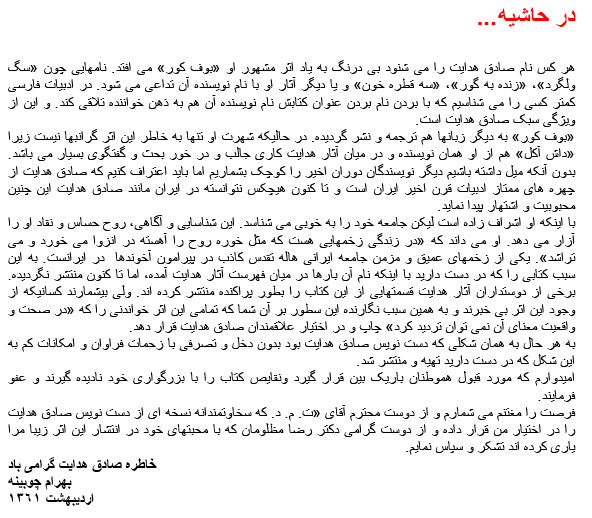
Sadegh Hedayat work published for first time
Bahram Choobineh has e-published "Kaarevaan e Eslaam" (Caravan of Islam) -- a work of Sadegh Hedaayat never before published. Read introduction by Choobineh. DOWNLOAD ENTIRE BOOK here
Current censorship
His work is coming under increasing attack in Europe from political Islamists, and many of his novels (Haji Aqa in particular) are no longer stocked in some French bookshops and libraries. The novels The Blind Owl and Haji Aqa were banned from the 18th Tehran International Book Fair in 2005. The Blind Owl contains a great deal of Buddhist and Hindu imagery. In Haji Aqa his characters explore the lack of meritocracy in Iran:
In order for the people to be kept in line, they must be kept hungry, needy, illiterate, and superstitious. If the grocer's child becomes literate, he not only will criticise my speech, but he will also utter words that neither you nor I will understand.... What would happen if the forage-seller's child turns out intelligent and capable—and mine, the son of a Haji, turns out lazy and foolish?

In November 2006, republication of Hedayat's work in uncensored form was banned in Iran, as part of a sweeping purge. However, surveillance of book-stalls is limited and it is apparently still possible to purchase the originals second-hand. The official website is also still online. Some material discussing the issue of censorship include:

Official Website of Sadeq Hedayat (in Persian)
Note: Many of Sadeq Hedayat's full texts can be legally downloaded from here: Mat'n-e Kāmel-e Dāstān-hā.
Photo Gallery of the Official Website of Sadeq Hedayat (highly recommended)
A Tribute to Sadeq Hedayat
Sadeq Hedayat's Life by Iraj Bashiri
Sadeq Hedayat's Corner, further articles and English translations by Iraj Bashiri
Persian Language & Literature — Sadeq Hedayat
Hedayat Page (in French)

Intellectual Movements in Iran
Persian literature
Persian philosophy
List of Iranian Intellectuals

Read more!

IRI destroys Iranian culture


The Occupational and anti-Iranian Islamic Republic regime continues to erase evidence of the rich and historic Iranian culture.

A photo taken inside one of the Jewish synagogues in Tehran. (Tehran Jewish Committee)7 ancient synagogues were recently torched in Tehran.AKI reported:
Seven ancient synagogues in the Iranian capital, Tehran, have been destroyed by local authorities. The synagogues were in the Oudlajan suburb of Tehran, where many Iranian Jews used to live. "These buildings, which were part of our cultural, artistic and architectural heritage were burnt to the ground," said Ahmad Mohit Tabatabaii, the director of the International Council of Museums’ (ICOM) office in Tehran. "With the excuse of renovating this ancient quarter, they are erasing a part of our history," said Tabatabaii.
h/t to: Gatewaypundit

Read more!

cartoon


Read more!

Tuesday, April 15, 2008

Blessed by a Sufi

My beautiful friend, Frieda from "inspire, move & touch":

I finally met a real Sufi!

Religions' goal is to bring love, if a religion does not do that, it isn't a religion. Religion must be like a musical instrument where the sole purpose is to bring joy and express love."

Read more!

Monday, April 14, 2008

Repression of tyre factory strike in Iran, workers abducted

Following three days of strike action at a tyre factory in northern Iran, Iranian security forces broke into the plant on Saturday and abducted at least 1,000 striking workers.The workers had been on strike at the Kian Tire Factory in the Alborz region of northern Iran since last Thursday, demanding the payment of unpaid wages. On Saturday evening, security forces entered the plant using bulldozers to tear down walls, and arrested around 1,000 workers.Several men evaded capture, making their escape through a sewer system, and managed to telephone a report to a local radio station. The location of the arrested workers is unknown, although those who escaped saw men led out of the factory and bundled into awaiting coaches, which they say were heading in the direction of Karaj, about 12 miles west of Tehran. Several workers were seen to have been badly beaten during the raid.The strike was the latest event in a long-running conflict over the non-payment of wages and poor working conditions at the plant.At least two strikes occurred in February, during which workers burned tyres in the yard of the factory after the main gate had been blocked by security forces. Similar scenes took place last week as workers created roadblocks of burning tyres on a highway near Tehran. Security forces were again called out on this occasion and attacked workers, who fought back, supported by local residents and youths, using sticks and stones. Kian Tire workers have not been paid for five months.

Read more!

Flirting with the Mullahs

Flirting with the Mullahs
Prof. Mohammad Parvin, Ph.D. and Hassan Daioleslam - 4/7/2008
Senator Dianne Feinstein is announced as the keynote speaker of an upcoming event in Capitol Hill on US-Iran relations.1 (April 6th) Trita Parsi, the president of the National Iranian American Council (NIAC) will moderate the conference. Parsi was the political advisor and assistant to now the federal prisoner Bob Ney. Ney’s conviction was partly related to the bribes he received from two London based international felons working with the Iranian regime.
The intentions of Senator Feinstein are not in question. Preventing a disastrous war with Iran is an honorable intent. How Senator’s objectives line up with those of Trita Parsi is a different issue. In 1999, Parsi and his Tehran based partner, Siamak Namazi kicked off a project to influence the US Congress and the decision making process in favor of reducing pressure off the Iranian theocratic rulers. In their famous roadmap,2 they called for the creation of an Iranian American lobby in the US "to create a balance between the competing Middle Eastern lobbies. Without it, Iran-bashing may become popular in Congress again." The “competing lobby” was AIPAC (American Israeli Public Affairs Committee). NIAC has followed the decorations of the roadmap to the last dot. 3
Parsi’s coauthor was Siamak Namazi, an important figure in the financial mafia of the Iranian regime. Along with his brother and sister, Namazi controls the "Atieh Bahar" firm in Tehran. "Atieh" is the leading consulting firm for foreign oil companies dealing with Tehran and maintains direct collaboration with the top leaders in Iran.3
So the question to Senator Feinstein is: why are you paving the way for those who explicitly declare that they intend to lobby you and your colleagues. Do you know who they are and why they do what they do?
In 2006, the Iran’s governmental newspaper, Aftab, 4 published an article decorated with Parsi's close-up picture. The article's title was: "Does the Iranian lobby get active"? The author concluded that this lobby in the US acts as the regime's "unofficial Diplomacy". Separately, Gholamreza Fathnejad, the head of the Iranian Interest Section in the US (in Washington DC) praised Trita Parsi's efforts and called for increased support for him. 5
When the first article exposing Parsi’s connections and activities, was published in US in April 2007, a large number of governmental newspapers came to his rescue, claiming that "the Jewish lobby is attacking the Iranian lobby." 6
The political implications of Senator Feinstein's speech in a session organized and moderated by Trita Parsi raise the more fundamental question about Democratic Party's attitude towards the Mullahs regime and their lobbying activities in the US. A case in point is Shahriar Afshar , from Senator Feinstein's own State, California.
In 1997, Afshar , a resident of San Diego, founded the Iranian Trade Associations to lobby the removal of US sanctions on Iran. Shahriar Afshar is also the president of "Iranian American Democrats in San Diego" which is affiliated to the Democratic Party and has participated in fundraisings with Senator Feinstein in the past. 7 Afshar is best known for his relations with the Iranian regime. He has been a usual participant and an active organizer of the Mullahs’ oil related events and conferences. For instance, Afshar's organization (ITA) actively helped to organize The 1998 Iranian Petroleum Conference in Cyprus which was sponsored and supported by the Iranian regime. Afshar pledged to the US oil companies that he was trying to lure to the conference, that: "With several high-level Iranian government officials in attendance, your company's success in Iran may well depend on your attendance at this dynamic conference.8
The Iranian community in the US and especially in California is profoundly shocked that their Senator is promoting lobbying groups with such clear agendas. In February 2008, a large number of Iranians gathered in Beverly Hill to protest Trita Parsi’s presence. Parsi's scheduled speech was consequently cancelled. While such gathering might not actually be possible in the confines of the Senate’s walls, it is up to the good Senator and her staff to do the due diligence of the background check.
Senator Feinstein’s participation in this meeting is also salt of the injury of the victims of human rights violations in Iran. NIAC is an organization which so far has refused to condemn human rights violations by the Iranian regime. In fact, it has taken an active role in justifying these atrocities arguing that the United States pressure for suspension of IRI’s atomic activities is the main cause of these violations! The systematic persecution of ethnic and religious minorities, the ongoing repression of women, and imprisonment torture and execution of many brave Iranians who don’t submit to IRI, as well as export of Islamic revolution and continuous threats of annihilating Israel are integral elements of this regime. Under the banner of opposition to war, NIAC has been promoting friendship with such a brutal regime. Two months ago, in a meeting held in the congress building, when Trita Parsi was asked why NIAC does not take any meaningful position against human rights violations by IRI, he replied: “NIAC is not a human rights organization. We do not have expertise in that area”!
Senator Feinstein, your good record in defense of human rights does not warrant your cooperation with such organization. It rather raises the expectation that you stand by freedom loving Iranian people and don’t allow a lobby group to use your good name in legitimizing a terrorist regime. This can be manifested in your support for the Senate Act S-970. As we witnessed in South Africa, a smart sanction will empower the Iranian people in their struggle to replace the religious dictatorship by a secular democracy and will eliminate the danger of war. There is no need for any military intervention. The only help expected from civilized nations is to stop helping and legitimizing the Mullahs’ regime until its atomic activities and human rights violations are stopped. Release of all political prisoners should be the first step.
Embracing Iranian mullahs or their lobbyists in the US will not bring us closer to peace. It emboldens the war mongers in Tehran. It buys them time to pursue their aggressive strive to gain hegemony in the region and the world. To prevent a disastrous war with Iran, stop mullah’s lobbyists. We agree with you that a different approach in dealing with Iran is needed. But dear Senator Feinstein, aren’t you just continuing the strategy that started with the infamous “Cake and Colt”, and has so far cost us thousands of American lives and hundreds of billions of dollars in debt?
Mohammad Parvin, Ph.D., is an adjunct professor at the California State University, an Aerospace Specialist, and Founding Director of the Mission for Establishment of Human Rights in Iran (MEHR) - http://mehr.org/ Hassan Daioleslam is an independent Iran Analyst and writer. He is well published in Farsi and English. He has appeared as an expert guest in the Voice of America-TV as well as other Persian media. Daioleslam has three decades of history of political activism and political scholarly analysis. http://iranianlobby.com/
Flirting with the Mullahs
The Iranian Cultural & Natural Heritage Year
Culturist Lessons from Iranian Textbooks
Islam & the Iranian Dilemma
Iranian Nuclear Program Remains In Full Flow
EXCLUSIVE INTERVIEW: MP Lord Waddington - Iran Regime Change Is "Essential"
Flirting with the Mullahs

Read more!

Sunday, April 13, 2008

Monday, April 07, 2008

http://www.cinema.ucla.edu/calendar/calendar.aspx

http://www.cinema.ucla.edu/calendar/calendar.aspx


302 East Melnitz . 405 Hilgard Ave . Los Angeles, CA . 90095-1323 . ph. (310)
206-8013Screenings & Public Programs
Special Events
Calendar
Tickets
Theater
Join Our Cineclub
Film Tours
Search Past Programs
Who We Are


SPECIAL GUESTS THIS WEEK AT THE WILDER

Saturday, April 12, 1:30 pm
Panel Discussion: The Art of Filmmaking in Contemporary Iran

Saturday, April 12, 7:00 & 8:45 pm
In Person: Heinz Emigholz


18TH ANNUAL CELEBRATION OF IRANIAN CINEMA


JUST ADDED!
Free Panel Discussion!
Saturday. April 12, 1:30-3:00 PM

THE ART OF FILMMAKING IN CONTEMPORARY IRAN
Eight visiting directors discuss filmmaking in the Islamic Republic of Iran.
Filmmakers on the panel include Amir Shahab Razavian, Kaveh Bahrami Moghaddam, Mehdi
Boostani, Rahbar Ghanbari, Delaram Karkheirankhoozani, Soran Mardookhi, Mansour Ali
Zabetian, Elham Hossein Zadeh. The panel will be moderated by Dr. Touraj Daryaee, a UC
Irvine professor of History of Iran and the Persianate World. Read More »

2008 marks the Archive's 18th annual Celebration of Iranian Cinema, and our program
this year is as eclectic and diverse as ever. This year's offerings include seven new
features from Iran and the Diaspora, as well as compelling new documentary and short works
on film and video.

A major identifiable theme in this year's program is Iranian culture, whether it's
pop culture-including a love triangle and murder that rocked Iran in 2002 (The Red Card)
and provided steamy headlines for the Iranian tabloids for months; military culture in
Night Bus and Those Three; small town culture in Dandelions Dance in the Wind; an
irreverent and entertaining "history" of the city of Tehran in Tehran Has No More
Pomegranates!; and an ode to one of the world's most important and enduring art forms in
Persian Carpet, which features contributions by contemporary Iran's leading filmmakers,
from Bahman Ghobadi to Rakhshan Bani-Etemad.

Nevertheless, most of the works in this series are by emerging directors and the
program provides audiences with the opportunity to discover new filmmaking talent from
Iran. We also hope to welcome several guests to present and discuss their work in person.
Please check our website at www.cinema.ucla.edu for updates on in-person guests for this
program.

All films are in Persian with English subtitles, unless otherwise noted.

Complete Schedule »


Heinz Emigholz: In Person
Saturday, April 12, 7:00 & 8:45 pm

German experimental filmmaker Heinz Emigholz has earned international acclaim for
his series of artful and rigorous documentaries on architect-iconoclasts ranging from
Louis Sullivan to Bruce Goff. ous documentaries on architect-iconoclasts ranging from
Louis Sullivan to Bruce Goff. Emigholz films architectural forms to elicit their
present-tense relationship to the world that surrounds them. Over the span of projection,
his deceptively spare presentational style acquires exquisite palimpsestic resonances,
converging cinematic and architectonic space-time, the real and the imaginary.

The Archive is honored to host Emigholz in-person for companion screenings of his
two latest films on the work of modernist architects Adolf Loos and Rudolf Schindler. In
Emigholz's words, "The two films together will show how Schindler could carry out and
further develop in freedom what Loos had conceived so consistently, and the degree to
which Loos had to land in a dead end here in Europe."

Complete Schedule »


VENUE
Unless noted all programs will screen at the Billy Wilder Theater, 10899 Wilshire
Blvd. @ Westwood Blvd.
(courtyard level of the Hammer Museum).

TICKETS
Advance tickets are available for $10 at www.cinema.ucla.edu. Tickets are also
available at the Billy Wilder Theater box office starting one hour before showtime:
$9, general admission; $8, Cineclub members, students, seniors and UCLA Alumni
Association members with ID;
$7, Cineclub members who are students or seniors.

PARKING
After 6 p.m. , $3 in the lot under the theater. Enter from Westwood Blvd. , just
north of Wilshire.

INFO
www.cinema.ucla.edu / 310.206.FILM


Forward email


This email was sent to cjmccormack@verizon.net, by archive@ucla.edu
Update Profile/Email Address | Instant removal with SafeUnsubscribeT | Privacy
Policy. Email Marketing by


UCLA Film & Television Archive | 302 East Melnitz | Box 951323 | Los Angeles |
CA | 90095-1323ReplyReply AllForwardTrashSpamMore actions... Print


Back to list Email 4 of 63

Read more!

Sunday, April 06, 2008

wonderous!

Read more!

Saturday, April 05, 2008

Israel's Tehran Connection?

Israel's Tehran connectionIsrael, while supposedly observing an ironclad boycott of all things Iranian, is happily buying Iranian oil
Richard Silverstein, Guardian
April 4, 2008

If you've ever wondered about the definition of hypocrisy you'll find the answer right here.Last month the Swiss foreign minister visited Iran and, together with President Ahmadinejad, attended the signing of a multi-billion euro contract for Iran to supply Switzerland with large amounts of natural gas over the next 25 years.The US State Department immediately condemned the deal and said it would be investigating whether it breached the Iran Sanctions Act. Israel complained too, describing the Swiss minister's visit to Tehran as an "act unfriendly to Israel". Various Jewish groups also joined in the protests, including the World Jewish Congress....more

Read more!

"The Game is Up": Time to Face Reality

"The game is up"
"Nahid Hattar, one of the prominent Jordanian opposition journalists, lays out the argument for what perhaps a lot of people instinctively grasp, namely that the events of the past week, even though they laid bare an intra-Shiite split, that split is actually a very positive thing. In fact these events, including what he calls the uprising of the Shiite masses of the South and Center of Iraq, mark the beginning of the end of the American occupation and potentially the start of a non-sectarian approach to Iraqi reconstruction. His main points": Read more

Read more!

Clean Break????

"Badr sectarian militias in Iraq are like a bigamist who really loves his two wives. You want to ask Badr leaders: now really, who do you really love more: the US or Iran"?(Thanks A***Head, abu-Khalil) And SCIRI loves both wives equally!!!

Meanwhile, Sayyid Muqtada al-Sadr is pursuing his plans to hold a million-man march on next Wednesday, the anniversary of the fall of the ancien regime and the beginning of the American military occupation.(thanks Juancole)

Muhsin al-Hakim, son of the leader of the Islamic Supreme Council in Iraq, `Abdul `Aziz al-Hakim, said Friday what we all know but Bush, Cheney and McCain won't acknowledge: "Tehran, by using its positive influence on the Iraqi nation, paved the way for the return of peace to Iraq and the new situation is the result of Iran's efforts. . ."(thanks Juancole)

Read more!

Friday, April 04, 2008

??


Iran torpedoes US plans for Iraqi oil

Read more!

Iran's proxy bribing Sunnis clergies across the ME

Stratfor:
Lebanese Shiite militant group Hezbollah has been making a concerted effort to win the support of Sunni religious scholars in Lebanon, particularly in the cities of Beirut, Saida, and Tripoli, according to a source in Lebanon. Hezbollah reportedly pays a monthly allowance to about 30 Sunni mullahs in Beirut. The paid ulema are divided into two categories: aides and associates. Aides receive $300 per month and are assigned duties such as making pro-Hezbollah statements and meeting with Hezbollah representatives, while associates get paid $200 per month to attend Hezbollah-sponsored events on a regular basis.Given the historic polarization between the Sunni and Shiite branches in the Islamic world, Shiite militants forging ties with Sunni religious figures is unusual, but not unprecedented. The Hezbollah campaign to enlist Sunni support in Lebanon sheds light on Iran’s ability to cross ideological and religious barriers to spread its influence in the Middle East.Aware of its military disadvantage versus its principal adversaries Israel and the United States, Iranian defense strategy relies heavily on Shiite nonstate actors like Hezbollah and the array of Iranian-sponsored Shiite militias in Iraq. In addition to Iraq and Lebanon, Iran has murky connections with sizable Shiite populations in Sunni-ruled Arab countries like Bahrain (75 percent Shiite), Kuwait (30 percent Shiite), Saudi Arabia (15 percent Shiite), Afghanistan (19 percent Shiite) and Qatar (16 percent Shiite). Even in predominantly Sunni Egypt, where Shia account for a mere 1 percent of the population, security forces are actively tracking down Shiite militant cells in the country believed to be financed by Iran.Though less apparent, the Iranians also have made inroads with a number of Sunni actors in the region, albeit to varying degrees. The overall intent in this strategy is to convince Iran’s rivals that Tehran has the ability to reach far beyond its borders to stir up trouble if sufficiently provoked.The most notable example of Shiite-Sunni cooperation is in the Palestinian territories, where Iran has built a strong relationship with Hamas and Palestinian Islamic Jihad. The absence of a functional Palestinian government has given Iran the opportunity to establish ties with these groups. Though the two Palestinian militant groups continue to rely heavily on their Sunni sponsors, such as Saudi Arabia, deteriorating conditions in the territories and Hamas’ desperation for material support has provided an opening for Iran to directly influence the Israeli-Palestinian conflict, thereby threatening Israel and Egypt. The exiled leaderships of Hamas and Palestinian Islamic Jihad are based in Syria, where the government is closely tied to Iran. Hamas also looks to Hezbollah for inspiration in overcoming the challenges of developing into a political movement while retaining a strong militant arm.Iran also has established links with the Sunni insurgencies in Iraq and Afghanistan. The relationship between Iran and these groups is highly paradoxical, given that a strengthened Taliban, al Qaeda or Baathist movement directly threatens Tehran. Iran’s support for these insurgencies is limited and extremely selective, however. Tehran’s goal is to deny U.S. forces the bandwidth needed to seriously threaten Iran from across its western and eastern borders.Iranian support for these insurgencies proceeds through third parties and is mostly limited to weapons transfers. In the case of Afghanistan, Iran can use cultural and linguistic ties with the country’s Tajik population and religious ties with Afghan Shia.In all of these cases, ideological differences cease to matter. The need for material support, a common adversary and the guise of a pan-Islamist agenda have formed a basis for Iran to establish useful connections in pockets of the Sunni world. Moreover, Iran’s successful projection of itself as the only state in the Muslim world willing to defy the United States and Israel has generated a great deal of appeal on the Arab street."
h/t to:Tigherhawk

Read more!

Heaven and Hell

daily consciousness tune-up 04.04.08
There is a wonderful story about a man who leaves the world and arrives at the pearly gates, where he is given a preview of heaven and hell. Both scenarios have the exact same setting: people sitting around a huge pot of stew, each holding a wooden spoon with a very long handle. In hell, he sees emaciated people trying to feed themselves, but try as they might, they're not able to get the food into their mouths using the cumbersome spoons.In heaven, on the other hand, the people look healthy, with nice, rosy complexions. The difference is that in heaven, they're feeding each other using their long spoons. They're sharing, because they understand that the only way they can eat, have the real fulfillment and sustenance that they need, is by taking care of one another.What is hell? Hell is not having the ability to share with others.

Which scenario will you choose today?

Read more!

What to Expect from The US Financial Markets

Our Confusing Economy, Explained
Listen Now [39 min 8 sec] add to playlist
Fresh Air from WHYY, April 3, 2008 · Perplexed by the U.S. economy? You're not alone. Law professor Michael Greenberger joins Fresh Air to explain the sub-prime mortgage crisis, credit defaults, the shaky future of other types of loans and what we can expect from the U.S. financial markets.
Greenberger is a professor at the University of Maryland School of Law and the director of the University's Center for Health and Homeland Security.

Read more!

Iranian NGO Starts Production of 'Beyond Fitna'

Official Mouthpiece of Islamafia: TEHRAN (FNA)- A Non-Governmental Organization in Iran has started production of a documentary called 'Beyond Fitna' to respond to far-right Dutch politician Geert Wilders' provocative dissertation 'Fitna'.

The Iranian organization called 'NGO Islam and Christianity' started production of the documentary after the Dutch lawmaker displayed his movie which urges Muslims to tear out "hate-filled" verses from the Qoran and starts and finishes with an insulting cartoon of Prophet Mohammad (Peace Be Upon Him). The NGO's documentary called 'Beyond Fitna' deals with incitement of violence in the Bible. Muslims believe that the book deemed holy by Christians today is a distorted version of the original Bible. 'Beyond Fitna' focuses on the orders given to worldwide Christians in the (distorted version of) Bible for stoking violence, committing genocide, attacking others, beheading and burning women and children who have been taken into captivity. The documentary recycles film clips from crimes committed by extremist Christians under the inspirations of the said Bible teachings, and aims to provide a response to the allegations made by Pope Benedict XVI, who called Islam a religion of violence after misunderstanding certain Organic verses. 'Beyond Fitna' is produced while an overwhelming wave of protest is shown by worldwide Muslim and Christian communities against Wilder's movie. Wilders' provocative dissertation Fitna hit the Internet March 27. Even before the seventeen minute film's release, protests erupted. The movie is a documentary-style exposé of American trash-journalist Bill O'Reilly's militant calls for violent demonstrations and reprisals against "unbelievers" who dare to oppose his dogma. Australia condemned the Dutch lawmaker's anti-Quran film, with the foreign minister calling it "highly offensive." Foreign Minister Stephen Smith rejected the film's premise of equating Islam with acts of terror and violence. "It is an obvious attempt to generate discord between faith communities," Smith said. "I strongly reject the ideas contained in the film and deplore its release." Muslim nations, the European Union and UN Secretary-General Ban Ki-moon have all expressed outrage over the film, which has sparked noisy street protests in many Islamic nations. The Dutch government has distanced itself from Wilders and tried to prevent the kind of backlash Denmark suffered over Prophet Mohammad (PBUH) cartoons. Prime Minister Jan Peter Balkenende said in a televised speech he rejected Wilders' views and was pleased by the initial restrained reactions of Dutch Muslim organizations. Thousands of Dutch people demonstrated Saturday in Amsterdam to show that Wilders does not represent the whole country. Dutch exporters have expressed fears of a possible boycott. The European Union supports the Dutch government's approach and believes the film serves no purpose other than "inflaming hatred," the Slovenian EU presidency said in a statement. "The European Union and its member states apply the principle of the freedom of speech which is part of our values and traditions. However, it should be exercised in a spirit of respect for religious and other beliefs and convictions."

Read more!

Make a Dance of your day!

i am a baby blue fifth chakra'd studebaker convertible
i am the fourth from the landing brown-carpeted step on garland circle
i am ignored red lips stroking your hair
i am tangerine fringe tickling the top of her silver damasked living room
i am the comma following the disappearing, webspinning secrets
i am the coocooing echo
i am clutter
i am mending--

Read more!

Thursday, April 03, 2008

Iran, Le Choix des Armes,

Forbes:
War with Iran??
Want to know how a U.S. strike on a newly nuclearized Iran might actually work? Turn to page 154 of Francois Heisbourg's extraordinary new book, Iran, the Choice of Arms, published in Paris but, alas, not yet in the English-speaking world. It's frightening, but as accurate as only an insider's insider can possibly be--down to the actual weapons America might launch and their impact on the military machine and civilian infrastructure and population of the nation that is perhaps the world's most dangerous and unpredictable power.
...
The irony of all this, of course, is that Iran, without a nuclear weapon, is well placed to claim leadership as the single most powerful nation of the Persian Gulf and perhaps of the Middle East itself. Yet, as Heisbourg so compellingly points out, if armed with a nuclear weapon, its advantage evaporates, as a nuclear arms race in the region would find a host of other neighboring states buying their way into the nuclear arms club and aligning themselves with the superpowers. Iran would again find itself isolated, alone, shunned and boycotted. Indeed the Iranian people, while they might accept being bashed by the Great Satan (George Bush's America), they "take badly their country being perceived by the world as a sort of leprous regime of the North Korean type rather than as a great nation," Heisbourg points out.

Read more!

Iran's Adventures in the Region will Fail

April 03, 2008 Asharq Alawsat Huda Al Husseini

Recently published in the US, the book "Peace Not Terror: Leaders of the Antiwar Movement Speak out against US Foreign Policy Post 9/11" by Mary Susannah Robbins includes studies written by experts and specialists about the region.One of the contributing writers is Mansour Farhang, Iranian author, university professor and former diplomat who served as revolutionary Iran's first ambassador to the United Nations. However, Farhang soon resigned his post in protest after Khomeini's regime rejected the UN Commission of Inquiry's recommendation to release American hostages in Tehran.Farhang returned to Iran to join the Mehdi Bazargan (the first prime minister following the Islamic revolution in 1979) and Abolhassan Banisadr's (first president of the Islamic republic) group. Later Bazargan died, Banisadr was granted political asylum in France and Farhang went into hiding then fled to Turkey. Since then, Farhang has settled in the US where he has published various books and teaches diplomatic history and international relations at Bennington College, Vermont.The former diplomat recalls Ayatollah Khomeini's regional aspirations, which were based on the leader's experience in Iran and his belief that the Iranian revolution could be exported to Iraq's Shia. Khomeini believed that "his ambitions did not depend on military operations, rather he believed that he could succeed in disseminating Iranian influence in Iraq through propaganda because he know the country well and had several colleagues there. Then the Arab and Islamic worlds would follow."Farhang maintains that Khomeini did not have a strategy, he wrote, "With the outbreak of the Iraqi-Iranian war in September 1980 and after the Iraq forces invaded Iran, Khomeini issued a fatwa to the Iraqi people; however it was believed that the fatwa was addressed to the Shia in Iraq. He believed that they would revolt against the war – but that did not happen. Khomeini issued another fatwa in which he likened Saddam Hussein to Yazid [Yazid Ibn Muawiyah Ibn Abu Sufyan] calling him a traitor even using the same expressions he had employed against the Shah [Reza Pahlavi] – but it was to no avail."According to Farhang, Khomeini wanted to issue a third fatwa but then-Iranian President Abolhassan Banisadr said to him, "You have issued two fatwas and no one has moved; this will diminish your credibility and prestige in the region – so why issue a third one, to which Khomeini replied: '"They are from Kufa in any case!"This incident was related to Farhang by Banisadr himself and the former also recalls Khomeini's meeting with German correspondent in Neauphle-le-Château. The correspondent had asked, "The Iranians say Persian Gulf and the Arabs call it the Arabian Gulf – how do you solve this problem? Khomeini answered: 'You could call it the Islamic Gulf.' However after he assumed power, someone reminded him of what he has said to which Khomeini replied: " the Arabs can go to Hell!"Farhang added, "It may be said that Khomeini had the most hatred for the Arabs over the past five centuries."I recounted to Farhang that when I interviewed Khomeini in Neauphle-le-Château, he refused to speak to me in Arabic and that his grandson Mustapha, who later died of mysterious causes, had assumed the task of translation.Farhang's response was, "He [Khomeini] was a fanatic. A number of Arab leaders, including Colonel Qaddafi, wanted to go to Neauphle-le-Château but he refused to receive them. The only Arab leader who met him was Yasser Arafat, because he had no authority."He also disclosed: "When the Iraqi-Iranian war first erupted, 12 Arab heads of state came to Tehran to mediate and try to stop the war but Khomeini refused to meet with any of them."In response to the question as to whether Iranian President Ahmadinejad had a strategic plan, Farhang said, "He addresses his words to the Arab people and has gained wide popularity in the Middle East – but not for anything he has achieved inasmuch as the fact that he answered to the people's despair, which is likely to lead to nothing.""Ahmadinejad is armed with the Iranian nuclear program," he continued, "and he considers it to be a potential force that can be exploited. Any state capable of enriching uranium to fuel reactors can later on enrich it to develop a nuclear bomb. Ahmadinejad is aware of this potential force that can be exploited. In this sense his policy is no different from the Shah's. He [the Shah] told his advisors in the nuclear field: 'We do not want an atomic bomb in the near future but we should had have the ability to develop one, should the need arise. And this is all what the Iranian politicians think of."This is why Farhang rules out the possibility of US President George W. Bush launching a war against Iran since Iran is still not capable of making an atomic bomb. It needs a period of five to eight years and therefore, there is no pressing need.The Iranian professor said, "The US naval and air force may strike Iran, however America knows fully well that Iran can retaliate by attacking US targets in the region and it can strike countries that maintain good relations with the US, such as Bahrain and Qatar."As for the next US president and the likelihood of he/she forgoing Bush's commitments and adopting a milder discourse with Iran, Farghang said, "If John McCain comes into office then we will witness an escalation of Bush's policy but the situation will be different if Barack Obama or Hillary Clinton came to power."Farhang disclosed: "I will tell you about the attempts made by former US president Bill Clinton – and that is where the tragedy of US-Iranian relations lies. In 1999, ex-secretary of state Madeleine Albright issued a public apology for the 1953 coup which had toppled [Mohammed] Mossadegh's regime and called for open dialogue between the US and Iran. Iranian President Mohammad Khatami was very keen to respond to the US invitation; however Hashemi Rafsanjani and Ayatollah Ali Khamenei refused to allow Khatami to reap the gain of starting up dialogue with the US while he was preparing for his election campaign to run for second term. Blinded by envy, they prevented him from negotiating with the US at the time when then-president Clinton had listened very closely to Khatami's UN speech [General Assembly Hall]. The US administration was prepared to discuss Iran's nuclear program, in addition to other pending issues between the two states. However, when Khatami's term ended in 2003 Iran brought forward Clinton's proposition but President Bush was embroiled in the aftermath of overthrowing the Taliban in Afghanistan and Saddam Hussein in Iraq and thus turned down the proposal for negotiation. In fact, he said: 'Iran is our next target.'""Which is why," Farhang continued, "if Obama or Clinton came to power and offered Iran a proposal; it will respond this time because it is in the regime's interest." He revealed that the Iranian regime is unified in its position regarding this matter and added that Khamenei said: "Our disagreement with the United States is not eternal – but the time has yet to come."Farhang's view is that: "Iran and America are like a couple that has had a bad marriage for the past 25 years that ended in a disastrous divorce and we are still awaiting the reconciliation."According to Farhang, Iran wants to normalize its relations with the US so long as the latter recognizes it as a chief player in the Gulf's security – it does not want to normalize relations on the basis of yielding to American demands.He elaborated, "Iran relishes the fact that it is the only state that challenges America's hegemony in the Middle East. If Washington is ready to deal with it as a player rather than just a 'client' state, as was the case with the Shah's Iran, then it will accept that position," and added, "regardless of our position towards the incumbent regime, Iran is concerned over its security and believes that the US wants to change the regime so that it may be headed by someone who is more suitable in its eyes. If we look at a map today we will see that Iran is surrounded by US military presence."Speaking of Iran's domestic affairs, Farhang disclosed that a new political-economic class had emerged and that it was comprised of the elite class of the Iranian Revolutionary Guard Corps (IRGC) and the Basij forces. Furthermore, he believes that the role of religious clerics will be marginalized by this class in approximately five to 10 years. "In the Islamic Republic's first parliament, there were 150 MPs who were clerics whereas presently, there are only six clerics."As for Syria, Farhang believes that it is benefiting from the situation; with knowledge that Iran supports Hamas and Hezbollah via Damascus. He reminded me that former Israeli prime minister Ariel Sharon had said that he liked the political process to a point that he wanted it "to last for a thousand years"."This sentiment applies to Iran," Farhang revealed, "since resolving the Israeli-Palestinian conflict would deny Iran its foremost pretext for meddling in the region," he said.But why does Iran continue to back Hezbollah when it means that Lebanon could be subjected to a war waged by Israel? The Iranian academic said, "Destroying Lebanon would only augment the severity of Arab wrath and this kind of tension can be exploited by Iran to mobilize the Arab world against the US pressure that is exerted upon it. The Iranian regime is not concerned with the interests of the Lebanese society; I do not think that Lebanon's fate is taken into consideration during the decision-making process in Tehran."Farhang believes that Iran's adventures in the region are doomed to fail. In the long run, it is impossible for Iran to seize control of Iraq, he said. This kind of expansion was achieved by ex-Egyptian president Jamal Abdel Nassar when he reached Yemen after which his influence began to dwindle."Iran's actions and the conflicts that it stirs up do not contribute to the security and interest of other states; in fact it tarnishes Iran's good image. If we want to know the future of the Iranian regime we should examine the state's internal affairs. As for its external affairs; what is going on is transient and tactical and it does not contribute anything to the state's supreme interest."
link to original article

Read more!

The Audacity of being audacious!

Arabs, Muslims battle US, Europeans over free speech at UNGENEVA:

Arab and Muslim countries defended Tuesday a resolution they pushed through at the United Nations to have the body's expert on free speech police individuals and news media for negative comments on Islam.The United States, Canada and some European countries criticized the role reversal for Kenyan legal expert Ambeyi Ligabo, who has reported to the global body on measures by dictatorships and repressive governments to restrict free speech.The U.S. and other Western nations warned that the Muslim-backed resolution at the U.N. Human Rights Council could curtail freedom of expression and help dictatorial regimes block dissenting views."The resolution adopted attempts to legitimize the criminalization of expression," said Warren W. Tichenor, the U.S. ambassador to the U.N. in Geneva.The statement proposed by Egypt and Pakistan, which passed 32-0 last week at the council, seeks to impose "restrictions on individuals rather than to emphasize the duty and responsibility of governments to guarantee, uphold, promote and protect human rights," Tichenor told the 47-nation body.

Read more!

A Nurse and her Inspiring story


Take a pin, stick it in a map of the world and chances are Simin Marefat has been there. A San Francisco nurse and health care volunteer, she's been to 62 countries - mostly in the Third World. She's fed children and changed diapers in Rwandan orphanages. Delivered babies in Zambia and Zimbabwe. Educated sex workers on HIV prevention in Thailand. Vaccinated children in Pakistani refugee camps. Taught EKG and the care of open-heart patients in her native Iran.

"I've traveled the world by myself," says Marefat, who lived in Iran until age 11. "A Middle Eastern woman does not do that."
"She's unstoppable," says her brother Bobby, an ophthalmologist in Topeka, Kan. "Do I worry about her? Yes. Do I try to talk her out of it? Absolutely not, because this is what she loves - it gets her juices flowing."


Usually she travels alone and plans nothing in advance. "I would just go and I'd be like, 'I'm a nurse practicing in the United States. I'm here to offer my services.' And they would put me to work."
Read more here

h/t to: Frida

Read more!

Wednesday, April 02, 2008

Christian refugee sent back to Iran

New Zealand: last-ditch attempt to stop the deportation of an Iranian Christian has been rejected by Associate Immigration Minister Shane Jones.


Mr Jones will not overrule an Immigration New Zealand decision to deport 25-year-old Birkenhead resident Bahareh Moradi.

His decision writes off the last chance Miss Moradi had to stay in New Zealand.

Her three brothers live in New Zealand. All have refugee status.

The Moradi family had applied for the deportation to be put on hold until after a High Court judicial review of Miss Moradi’s case in July.

That request was turned down by the High Court in March.

As the North Shore Times went to print, Miss Moradi was waiting to be sent to Iran by immigration officials.

It is feared going back to Iran could be dangerous because she has become a Christian.

Under Sharia law, converting from Islam to Christianity is a sin and can be punished by death.

Her pastor at St Aiden’s Presbyterian Rinny Westra is shocked at the minister’s decision to uphold the deportation order.

He says it is based on flawed reports from the Refugee Status Appeals Authority and Immigration New Zealand.

"I consider it a complete miscarriage of justice.

"I testified to her Christian commitment and I still testify to that."

Northcote MP Jonathan Coleman says he has done all he can to help Miss Moradi.

He presented a petition organised by Mr Westra to Parliament in March.

It was referred to select committee.

"What do you do? We have to accept it.

"Shane Jones has acted on the advice of his officials and they’ve said there isn’t a case to keep her here."

A spokesperson for Mr Jones says he is unable to comment unless the Moradi family signs a privacy waiver.

Miss Moradi was first declined for refugee status in 2006.

An appeal against that decision was declined by the Refugee Status Appeals Authority in 2007.

Its decision called her Christian conversion into question, despite Mr Westra’s testimony that her religious belief was genuine. The family then spent $5000 applying for a High Court judicial review of the decision, which is scheduled for July 28.

Immigration New Zealand refused to wait until then to deport Miss Moradi, and sent notice she would be deported on March 25 or 26.

Another $2500 was spent on the recently declined attempt to get a High Court injunction on the move.

The Labour Department, which oversees Immigration New Zealand, is refusing to comment on Miss Moradi’s case while it is before the courts.

Its official statement says the fact Miss Moradi has lodged judicial review proceedings does not necessarily stop deportation.

Read more!

The Iranian Web of Influence in the United States

IranvaJahan: On March 21, 2008, the U.S. Commerce Department’s Bureau of Industry and Security (BIS) announced its decision to penalize three Iranian-connected companies as "they knowingly exported three U.S. origin aircraft to Iran in violation of the Export Administration Regulations (“EAR”) and are preparing to re-export three additional U.S. origin aircraft to Iran in further violation of the EAR."1The principal firm among these is Balli Group PLC based in London. Iranian brothers Vahid and Hassan Alaghband own the company. Balli owns a private bank and numerous major enterprises inside Iran with strong ties to the Iranian regime. It is well understood that no company can reach the Balli's success and status in Iran without direct support of Mafia Dons inside the mullah’s circle of power. The ramifications of selling a few used aircrafts to Iran transcends beyond the criminal act of a few merchants circumventing international sanctions to make hundreds of millions of dollars. It is a symptom of the broadening of the Mullah’s web of influence in the US.Five years ago, the Iranian regime tried to buy an aircraft through its London based proxies. At that time, Congressman Bob Ney was bribed by two international felons to introduce legislation to dissolve the US sanctions and facilitate the sale of a VIP airplane to Iran to be used by Hashemi Rafsanjani.2-3-4Eventually, Bob Ney ended up in prison. The Syrian arm dealer, Fouad Alzayat, is sued in British courts by the Iranian regime. Some $80M of the Iranian people’s money evaporated in the process.Similar to Ney and his circle, the Alaghband brothers are also accustomed to legal problems. After they bought out Klockner AG in Germany in 2001, Vahid was jailed in 2003 and later, a German court fined them €4M and handed down suspended jail sentences (2005). The Alaghband brothers waived their right to appeal.5-6While this time around, the outcome of their encounter with US law enforcement is not that rosy, the Alaghband brothers, in previous occasions, have been more successful in circumventing the sanctions.Shockingly, Balli Group represents the US Corporations Xerox and Caterpillar in Iran, and has numerous partnerships with other US corporations. How could US companies enter the Iranian market while there are now more sanctions against Iran than there were a decade ago? These companies have profited from the loopholes in the sanction laws. Their actions have been possible because of the lack of political will in the US in enforcing the sanctions and closing its loopholes. The indifferent and unconcerned attitude in the US roots back to the efforts of the Iranian lobby in the US for the past decade.In 1997, many US corporations, including Caterpillar, came together and started to fight the ILSA (Iran Libya Sanction Act). This fight reached its summit in 2001 when the Act came back to the Congress for its renewal. It passed by a large majority in the Congress and the Senate, and was extended for years. In the midst of despair, Bob Ney came up with an encouraging and visionary idea:7
“The ILSA vote doesn’t look very promising, but that doesn’t mean the struggle should stop on this entire issue. It is a matter of education and re-education and people getting together and forming a citizen’s lobby to make sure those members of Congress and their offices are educated on this issue.”A year later, Ney's Iranian advisor, Trita Parsi, became the president of an organization called the National Iranian American Council (NIAC). As I have explained in detail,8 Parsi and his Iran based partner Siamak Namazi, unmasked a roadmap in 1999 to create an Iranian lobby in the US to influence the Congress.To this date, NIAC has not diverted a bit from the roadmap. Namizi, along with his father, brother and sister, are notorious proprietors of numerous key enterprises in Iran facilitating the mullahs’ financial and business affairs. The NIAC’s role in lobbying for relieving pressure off Tehran’s rulers, under the disguise of empowering Iranian-Americans, is now well exposed. Even the Iranian pro-government newspaper Aftab, described these activities as the "Iranian lobby" acting as the regime's "unofficial diplomacy."10In addition to this "classic" lobbying effort, mullahs have now focused on using the mafia web of businesses connected to them to influence the US policies towards their interests. Naturally, some American businesses which see financial benefits in dealing with Iran and entering Iran’s markets have not resisted lining up with Iran’s financial Mafia.To recruit Iranian-American executives of the US companies as new members to its web, the Iranian regime, has undertaken a new initiative spearheaded by Siamak Namazi in Tehran. In June 2007, the newly founded organization called the "International Association of Iranian Managers (I-AIM) held a major workshop in Tehran.10Abbas Maleki, the Iranian deputy foreign minister under Rafsanjani, advisor to the Supreme Leader and one of the chief organizers of Iranian lobby in the US, was one of the key speakers. Hassan Alaghband from Balli group was another key speaker and one of the main supporters of the event. Namazi is certainly a known figure in the Mullah’s lobby machinery in the West. Following the trails from this meeting leads to the discovery of the broadening web of influence of mullahs in the US involving some new players and many of the familiar faces of the Mafia web.11The Iranian lobby in the US is financially fed by sources that are conspicuously tangled with Tehran’s interests. One jaw dropping example: Vahid Alaghband (the elder brother) is a major donor (among very few) and an "ambassador and supporter extraordinaire" of US based Parsa foundation.12 -13-14 This group has, in turn, been a principal financial supporter of NIAC in 2007. It is, indeed, a small world! Certainly there is strong evidence than the Mullahs’ web of influence in the US, including a number of lobby organizations, business interests and pseudo-academics are hard at work to reduce pressure on Tehran and buy them time to pursue their aspiration to gain hegemony in the region and the world. The unavoidable end result may be a catastrophic war between Iran and the US. To prevent that war, we must stop the Iranian lobby and their American cohort enterprises. This is not the case of a smuggler helping a mullah get an airplane ride. This is a matter of national security and the interest of the Iranian and American people.Notes:1- http://www.bis.doc.gov/news/2008/bis_tdo03212008.html2- Bob Ney's plea agreement: http://www.usdoj.gov/opa/pr/2006/September/06_crm_622.html3- Iranian newspaper: http://baztab.com/news/24835.php4- Iran versus Fouad ALzayat in British court http://business.timesonline.co.uk/tol/business/law/article3505782.ece5- Vahid Alaghband's 11 month prison: http://www.bloomberg.com/apps/news?pid=10000100&sid=aEodr6ltrnoQ&refer=germany6- Vahid and Hassan Alaghband sentenced for fiduciary duties: http://www.kloeckner.de/investor/en/pm.php?type=pm&id=92&year=20057- Ney told AIC in a June 2001 speech. http://www.american-iranian.org/pubs/aicupdate/05262005.html8- Iran's Oil Mafia: http://www.frontpagemag.com/Articles/Read.aspx?GUID=b30e945b-5f1f-4a57-a7aa-f4975d12fc4c9- Aftab Newspaper, http://www.aftabnews.ir/vdccpoq2biqpp.html10- I-Aim 23-28nJune event: http://www.i-aim.org/content/en/video-entrepreneurship/video-entrepreneurship .aspx11- I-Aim 23-28nJune event: http://www.i-aim.org/content/en/video-entrepreneurship/video-entrepreneurship .aspx12- Parsa's major donors: http://www.parsacf.org/honor-roll/honor roll/avicenna/?searchterm=vahid alaghband
13- Vahid Alaghband, Ambassador and … EVENING PROGRAM14- Parsa donation to NIAC: http://www.parsacf.org/grant-seekers/past-granteesHassan Daioleslam is an independent Iran analyst and writer. He is well published in Farsi and English. He has appeared as an expert guest on the Voice of America-TV as well as in other Persian media. Daioleslam has three decades of history of political activism and political scholarly analysis.
link to original article

Read more!